
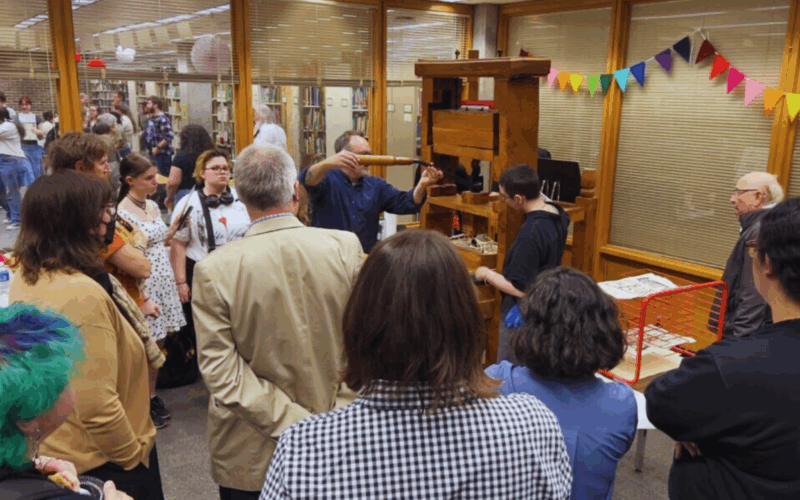
On April 28 approximately 200 NIU students, faculty and staff members, alumni, and community members gathered on Founders Memorial Library’s fourth floor to celebrate the grand opening of the NIU Booklab. The lab is an interdisciplinary initiative originally developed by faculty members in the English Department and University Libraries, which focuses on Book History. Book history is the interdisciplinary study of how human beings have created, disseminated, and received written material, examining the social, cultural, and economic impact of books. Long an important part of the humanities, Book History has grown rapidly in recent years, in part because scholars and students seek to find ways to think historically and critically about more recent revolutions in information technology, including digital media, the web, and social media.
Grand opening event participants enjoyed demonstrations of printmaking, as well as basic bookbinding and stitching, electric and manual typewriters, and quill writing. The event also furnished an opportunity to examine the Booklab’s several other manual printing presses, as well as a collection of movable type and other printing tools, and a short video discussing the Booklab’s founding, prepared by NIU Media Services.
Students enrolled in Technologies of the Word (ENGL 398), a new class taught by Dr. Nicole Clifton, Hainds Distinguished Professor of English, also displayed and discussed their projects with those in attendance. Describing the new class’s focus, Dr. Clifton asked “How did writing happen before computers or phones? People are used to doing everything electronically now. Technologies of the Word is this whole history of ‘things’ that goes back, really, to the beginning. You don’t have history until you can write it down in some way — it’s writing that makes history. Before that, you have to deal with archaeology.” Recording their progress in analog form via lab notebooks, Clifton’s students reduced writing to its essential elements — making their own paper, cutting quills and dipping into ink to script assignments.
Technologies of the Word student projects featured at the grand opening event included Grace O’Boyle and Jami Stewart’s medieval-style edition of the well-known children’s book Good Night, Moon; Justin Ivy’s presentation on medieval and later illustration styles and technologies; Anna Gargula’s `Zine on lesbian fashion; and Jacob Downing’s leather-bound edition of his own creative work.
Students in ENGL 398 enjoyed an opportunity to reflect on their experience. One wrote: “There are many small things that didn’t go perfectly to plan over the course of doing this project. I can see them all when I look at the finished book, and they do bother me a little bit. Luckily, my joy at being able to hold a book that I designed and made in my hands outweighs that. I am so proud of how this [project] went, and can’t wait to display it on my bookshelves.
Another observed that “It doesn’t matter the trial and error, I would still do this all over again the exact same way. If I had to give some advice to future students that would take this class… I would say to have fun, show up to the workshops, and allow yourself to get lost in the art because that is when true creativity is born. The book lab allowed space for creativity and adventure. It is a space where students’ love for literature, arts, and history between the two, to be loved out loud. Which is so ironic because the library is supposed to be a quiet place.”
The Booklab’s grand opening reflects expenditures made with a portion of the money raised from donors in 2024. It also represents the efforts of other members of the university community. Since beginning their collaboration, Adams-Campbell and McGowan have drawn on both the administrative and academic sides of the institution. Printmaking Professor Michael Barnes from the School of Art and Design has rebuilt several pieces of NIU’s half-century-old press by manual labor — “primitive-style,” as he calls it. “Students are using their hands so much less, like in the physical sense of drawing on paper; they have their iPads now, and they can do amazing things with those,” Barnes said. “But the hand-eye coordination that they get from smudging, charcoal or ink on a piece of paper, or scratching into a piece of copper, has a visceral quality to it. It develops other senses in your body. This wonderful project advocates for that sense of holistic education.”
English Chair and Professor Scott Balcerzak, Ph.D. observed “When you realize the humanities are dictated by the history of technology, it’s not wild to go from learning about presses to generative AI and other forms of digital communication. NIU’s Booklab builds off what we already have toward further potential innovation and curriculum development.”
“I am proud of all the faculty and graduate students who worked so hard to bring this to fruition,” said Robert Brinkmann, Ph.D., dean of the College of Liberal Arts and Sciences. “The Booklab represents a marvelous transdisciplinary project that focuses on the heart of what drives many of us to scholarly pursuits — the book.”
University Libraries Dean Fred Barnhart, JD, MLS, took a long view of the Booklab’s significance: “The invention of the printing press wasn’t just a technological breakthrough — it fundamentally changed the course of education, politics, religion and culture. With the Booklab, we want to create a space where people can explore those ideas, experiment with old and new tools, and see themselves as part of the story of the printed word.”
NIU historian Brian Sandberg discussed the printing press’ historical significance in more detail. “Mechanical printing presses first developed in Europe during the 1450s. Manuscript writing and copying had previously defined the fields of knowledge production and dissemination, but printing presses that utilized metal moveable type allowed new precision in reproducing text. By the beginning of the Reformation movements in the early sixteenth century, printed pamphlets delivered polemical arguments and justifications for religious warfare in a divided Europe. Printed pamphlets also communicated news of political developments, battles, sieges, and colonial conquest, shaping perceptions of the entire early modern world. Students in the NIU Book Lab will be able to consider whether or not these developments constituted a “Printing Revolution,” while examining the ways in which early modern printing created patterns of book publishing, scientific discourse, news dissemination, and polemical debate that shape our contemporary world.”
John Etheredge (Class of 1980), a retired journalist, attended the event and observed “As the publishing industry continues to change and evolve, I believe it is all the more important for current and future NIU students to gain an understanding of the history of the printed word. The Booklab displays help bring that history to life. I firmly believe those who know history can better understand people, cultures and events while also, hopefully, avoiding some of the mistakes of the past.”
